

Elevate your professional style with personalized footwear
Off-the-shelf shoes are designed for the average foot, not yours. Yet most professionals spend thousands on tailored suits and premium briefcases, then undermine the entire look with generic footwear from a department store rack. Personalized footwear provides perfect fit, superior comfort, and unique customization that complements your wardrobe and expresses your individual style. In this guide, you’ll learn why custom shoes matter for your career, how to choose the right level of customization, and how to build a cohesive professional wardrobe around footwear that actually works for you.
Table of Contents
- Why personalized footwear matters for professionals
- Fit, comfort, and health advantages of personalized shoes
- Levels of customization: Ready-to-wear, made-to-order, and true bespoke
- Choosing design features to express your personal brand
- How to integrate personalized footwear into your work wardrobe
- Upgrade your professional look with MySartorial
- Frequently asked questions
Key Takeaways
| Point | Details |
|---|---|
| Style and brand impact | Personalized shoes boost your professional image and strengthen your personal brand. |
| Fit and comfort benefits | Custom footwear relieves pain and improves workplace comfort compared to standard options. |
| Levels of personalization | Options include ready-to-wear, made-to-order, and bespoke; each fits different needs and budgets. |
| Practical wardrobe integration | Pairing personalized shoes with your business attire sets you apart with confidence and versatility. |
Why personalized footwear matters for professionals
First impressions form in seconds, and what you wear from the waist down communicates just as much as a firm handshake. Shoes are one of the first things people notice, and worn-down heels or a poor fit signal carelessness. In contrast, a well-crafted, personalized shoe signals that you pay attention to detail, which is exactly the message you want to send in a boardroom or client meeting.
Custom footwear signals attention to detail and individuality, two qualities that are crucial for personal branding in business. Your shoes become part of your professional signature, something colleagues and clients remember. That kind of subtle, consistent impression compounds over time.
The market is responding to this shift. Bespoke and made-to-order footwear is growing rapidly, driven by professionals who want more than what mass production offers. AI-assisted customization tools now let buyers preview patina finishes, sole options, and stitching colors before committing to a purchase.
Here are the key reasons professionals are moving toward personalized footwear:
- Unique identity: No two pairs look exactly alike, reinforcing your personal brand
- Better fit: Custom lasts accommodate your actual foot shape, not a statistical average
- Longevity: Quality construction like Goodyear welting means your shoes can be resoled and last decades
- Versatility: Thoughtful customization produces shoes that work across multiple professional settings
- Coordinated style: Matching finishes across shoes, belts, and accessories creates a polished, unified look
“The shoes you wear to a meeting tell the room whether you take the details seriously. A custom shoe says you do.” — Style consultant perspective on professional dressing
For a deeper look at the styles that resonate most in executive settings, explore the types of luxury shoes that are gaining traction in 2026, and understand the broader luxury footwear role in modern business attire.
Fit, comfort, and health advantages of personalized shoes
Comfort is not a luxury. For professionals who spend eight to twelve hours on their feet or moving between meetings, the wrong shoe can cause real physical damage over time. Mass-market shoes are built around average measurements, which means they fit almost no one perfectly.

Empirical data shows that custom orthoses reduce peak heel impact force, improve plantar pressure distribution, and enhance overall comfort. That translates directly to less fatigue, better posture, and fewer injuries over a long workday. Your energy stays focused on performance, not pain.
Research on orthotic prescriptions shows that 58% of custom foot orthoses are symmetrical, with features like varus corrections and structured shells, primarily addressing plantar heel pain. This level of precision is simply not available in off-the-shelf footwear.
Pro Tip: When selecting business shoes, prioritize a last shape that matches your foot’s natural width and arch. A shoe that looks perfect but compresses your toes will cost you in comfort and health within months.
Here’s how personalized and off-the-shelf footwear compare across the metrics that matter most to professionals:
| Feature | Personalized shoes | Off-the-shelf shoes |
|---|---|---|
| Fit accuracy | Tailored to your foot shape | Standardized sizing |
| Arch support | Custom or built-in orthotic options | Generic insole |
| Heel impact reduction | Clinically supported improvement | Minimal engineering |
| Comfort over long days | High, with proper construction | Variable, often declines |
| Resolability | Yes, with Goodyear welt | Rarely possible |
| Longevity | 10 to 20+ years with care | 1 to 3 years typical |
For professionals dealing with foot fatigue, learning how to reduce foot pain through smarter shoe choices is a practical starting point. And if you want to understand why custom dress shoes for bankers and finance professionals have become a standard investment, the reasoning goes well beyond aesthetics.
Levels of customization: Ready-to-wear, made-to-order, and true bespoke
Not every professional needs a fully bespoke shoe. Understanding the spectrum of options helps you invest at the right level for your needs, budget, and foot anatomy.
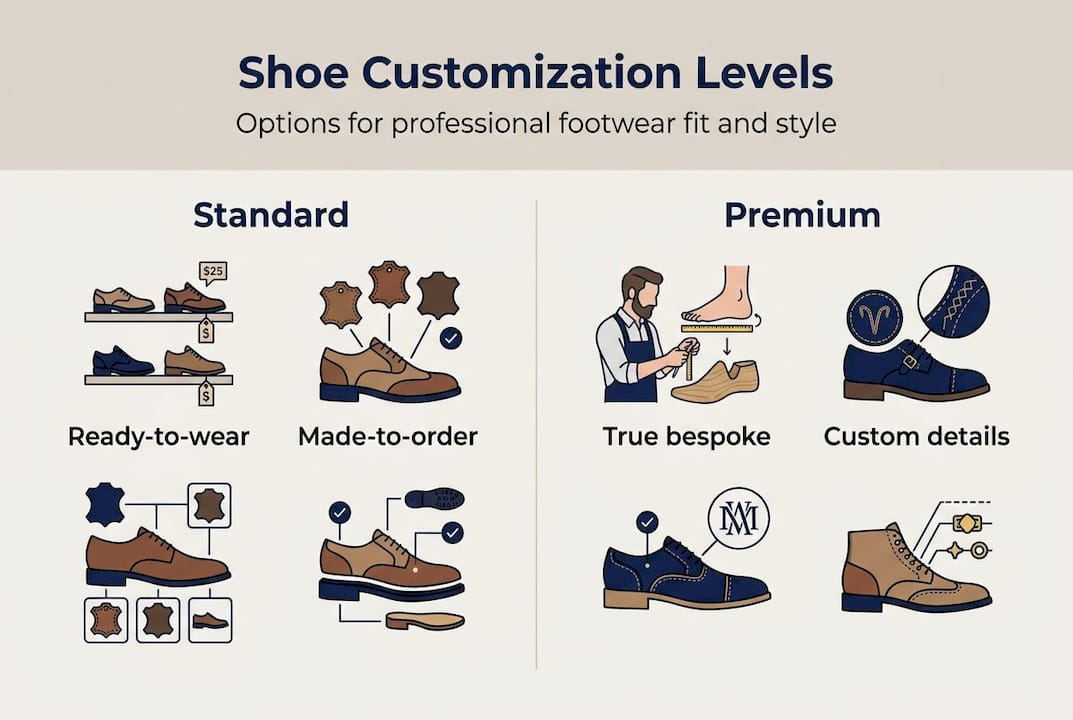
Here is how the three main tiers break down:
- Ready-to-wear (RTW): Pre-made in standard sizes and widths. Quality varies widely. Best for professionals with average foot dimensions who want elevated style without a wait time.
- Made-to-order (MTO): You select materials, colors, finishes, and sometimes width options, but the shoe is built on a standard last. Turnaround is typically four to twelve weeks. This is the sweet spot for most professionals.
- True bespoke: A last is carved specifically for your foot using detailed measurements or molds. Every element is custom. Turnaround can be six months or more, and prices reflect the craft involved.
| Tier | Price range | Turnaround | Best for |
|---|---|---|---|
| Ready-to-wear | $150 to $500 | Immediate | Standard foot shapes, style upgrades |
| Made-to-order | $400 to $1,500 | 4 to 12 weeks | Personalized style, moderate fit needs |
| True bespoke | $1,500 and up | 3 to 6+ months | Unique anatomy, maximum fit and luxury |
High symmetry in prescriptions suggests that off-the-shelf solutions may work for many people, which means full bespoke is not always necessary. However, for professionals with wide feet, high arches, or asymmetrical foot shapes, true bespoke processes using bio-foam molds guarantee a fit that no standard last can replicate.
To evaluate which tier fits your goals, ask yourself these questions:
- Do you have any recurring foot pain or discomfort in standard shoes?
- How often do you wear dress shoes, and for how many hours at a time?
- Is your foot shape standard, or do you struggle to find shoes that fit well off the rack?
- What is your budget, and are you looking for one signature pair or a full rotation?
- How important is it that your shoes are visually distinct from what colleagues wear?
For a thorough breakdown of what the process involves, the bespoke shoe design guide covers the craft in detail. You can also explore customized luxury footwear options and understand why MTO personalized shoes are the most practical entry point for most professionals.
Choosing design features to express your personal brand
Once you’ve chosen your customization tier, the real creative work begins. The design details you select, from leather type to sole color, are the vocabulary of your professional identity. Get them right, and your shoes become a quiet but powerful statement.
Bespoke and AI-customized dress shoes enhance professional style by providing unique customization that complements tailored suits and expresses individual character. The key is intentionality. Every choice should reinforce the image you want to project.
Here are the most impactful customization options professionals use:
- Patina finishes: Hand-applied color gradients that give shoes depth and a one-of-a-kind look
- Stitching color: Contrasting or tonal stitching adds visual interest without being loud
- Sole options: Leather soles for formal settings, rubber-reinforced for travel and wet weather
- Lining color: A personal touch visible only when you remove the shoe, a subtle signature
- Monogramming: Initials stamped or embossed inside the shoe or on the heel
- Toe shape: Square, round, or chisel toe changes the entire character of the shoe
- Leather type: Full-grain calf for classic formality, suede for business casual, cordovan for durability
Pro Tip: Build a consistent color palette across your shoes, belt, and bag. If your shoes are dark brown with a cognac patina, your belt and briefcase should echo those tones. This level of coordination reads as intentional and polished, not accidental.
For professionals ready to act on this, the guide to customizing formal footwear offers practical direction. The custom shoe selection guide helps you narrow down choices based on your wardrobe, and the luxury shoe crafting guide explains how materials and construction affect the final result.
How to integrate personalized footwear into your work wardrobe
Owning a great pair of custom shoes is only half the equation. Knowing how to build a wardrobe around them is what creates a consistently strong professional presence. The goal is versatility without sacrificing distinctiveness.
Personalized footwear elevates corporate wardrobes by signaling attention to detail and individuality, which is crucial for personal branding in business. That signal only works when the rest of your outfit supports it.
Follow these steps to integrate custom shoes into your professional wardrobe:
- Start with one versatile pair. A dark brown or black Oxford or Derby in a classic silhouette works across nearly every business setting.
- Audit your existing wardrobe. Identify the suits, trousers, and blazers you wear most, then choose shoe colors and finishes that complement them.
- Add a second pair for business casual. A Chelsea boot or loafer in a warm tan or cognac bridges the gap between formal and relaxed settings.
- Coordinate accessories. Match your belt and bag to your shoe palette for a cohesive look.
- Rotate your shoes. Wearing the same pair daily breaks down leather faster. Two or three pairs in rotation extends their life significantly.
Here are the colorways and styles that work across the widest range of professional looks:
- Black Oxford: Boardroom presentations, formal client meetings, black-tie adjacent events
- Dark brown Derby: Versatile across suits and smart trousers, works in most corporate environments
- Cognac loafer: Business casual Fridays, networking events, creative industry meetings
- Navy or burgundy Chelsea boot: Business travel, evening client dinners, conference settings
- Tan suede Derby: Smart casual, startup environments, outdoor networking events
For scenario-specific guidance on pairing shoes with different professional outfits, the integrating luxury shoes resource covers real-world applications in detail.
Upgrade your professional look with MySartorial
If this guide has shifted how you think about footwear, the next step is finding a brand that delivers on every dimension we’ve covered. At MySartorial, we offer 150+ handcrafted European shoes across formal, casual, and specialty collections, all with genuine customization options built into the shopping experience.
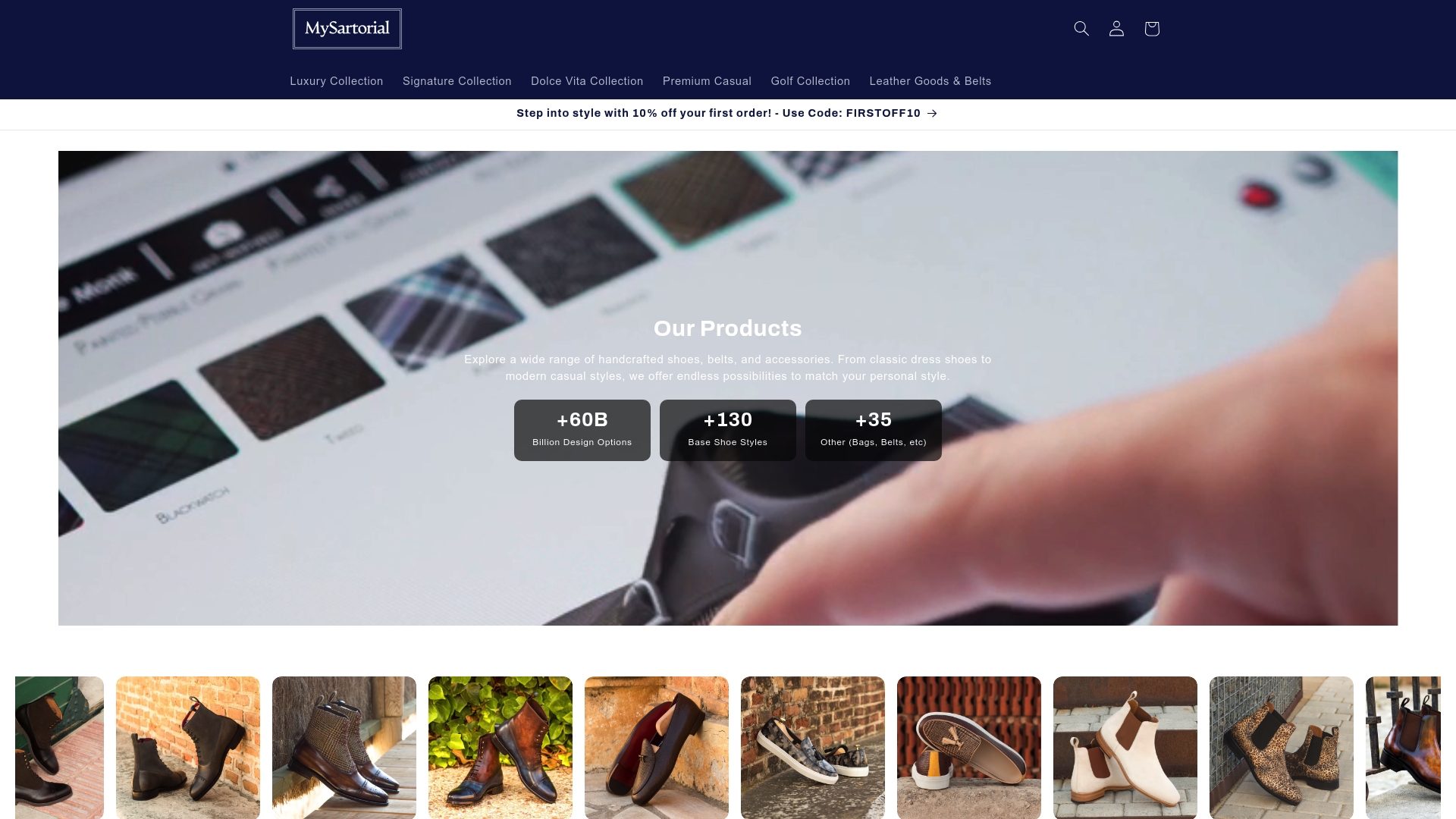
You can choose your finishes, stitching, sole type, and patina before you add to cart, so every pair reflects your personal style and professional identity. Our leather works collection showcases the craftsmanship behind each shoe, and our leather goods and belts let you coordinate your entire look from the ground up. Whether you’re investing in your first custom Oxford or building out a full wardrobe rotation, MySartorial gives you the tools to do it with intention.
Frequently asked questions
Are personalized shoes worth the investment for professionals?
Personalized shoes offer lasting comfort, a stronger professional image, and a distinctive personal brand, making them a smart long-term investment that outperforms cheaper alternatives over time.
What’s the difference between made-to-order and true bespoke shoes?
Made-to-order lets you customize materials and finishes on a standard last, while true bespoke uses bio-foam molds or detailed measurements to build a last specific to your foot anatomy.
Do personalized shoes really reduce foot pain and improve comfort?
Custom orthoses reduce peak heel impact force and improve plantar pressure distribution, and orthotic prescriptions show they are primarily used to address plantar heel pain, confirming real clinical benefits.
How can I ensure my personalized shoes fit my corporate dress code?
Choose classic silhouettes like Oxfords or Derbies in black or dark brown for conservative environments, and complement your custom suit by selecting finishes and tones that align with your existing wardrobe palette.