

Formal shoe care guide 2026: maintain elegance and durability
Luxury formal shoes represent a significant investment for professionals in finance, law, and consulting. Yet many find their expensive footwear deteriorating rapidly due to inadequate maintenance routines. Neglected leather develops cracks, loses its refined finish, and requires costly replacement far sooner than necessary. This comprehensive guide delivers expert techniques to preserve your formal shoes’ elegance and extend their lifespan by up to 50%, protecting both your professional image and your investment.
Table of Contents
- Preparation: Essential Tools And Understanding Your Shoes
- Execution: Step-By-Step Leather Shoe Cleaning And Conditioning
- Verification: Maintaining Shoe Shape And Finishing Touches
- The Professional Impact And Return On Investment Of Expert Shoe Care
- Enhance Your Shoe Care With Premium Leather Goods From MySartorial
Key takeaways
| Point | Details |
|---|---|
| Regular maintenance extends lifespan | Proper cleaning and conditioning can extend leather shoe lifespan by up to 50%, significantly reducing replacement costs. |
| Product selection matters | Using correct cleaners and conditioners prevents damage and preserves the luxury appearance your professional image demands. |
| Shape preservation is essential | Cedarwood shoe trees maintain structural integrity, absorb moisture, and prevent creasing that degrades shoe aesthetics. |
| Professional polish adds value | Expert polishing techniques enhance both appearance and monetary value while conveying attention to detail in high-income sectors. |
| Neglect costs more | Skipping care routines leads to dryness, cracking, and premature replacement that far exceeds maintenance investment. |
Preparation: essential tools and understanding your shoes
Before you begin any maintenance routine, understanding your leather type determines which products and techniques will preserve rather than damage your investment. Different leathers require specific care approaches. Full-grain leather, the highest quality found in luxury formal shoes, needs gentle cleaning and rich conditioning. Patent leather demands specialized cleaners that won’t dull its signature shine. Suede and nubuck require completely different brush types and waterproofing treatments.
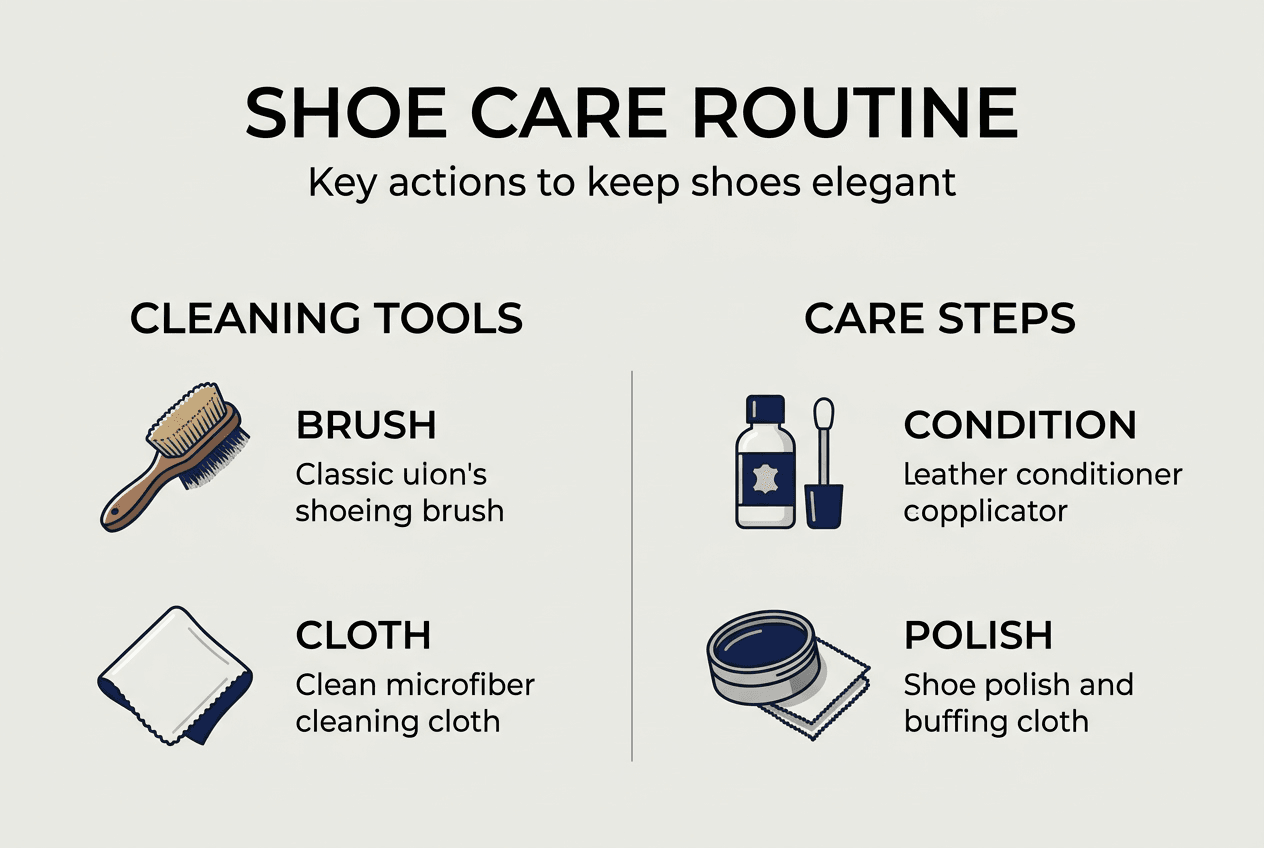
Gathering the right tools ensures you can execute proper care without improvising with household products that might harm delicate leather. Your essential toolkit should include several specific items. A soft horsehair brush removes surface dust and dirt without scratching. Microfiber cloths apply products evenly and buff to a professional shine. Using specific cleaning agents like Saphir Medaille d’Or Leather Cleanser maintains leather integrity far better than generic alternatives. Cedarwood shoe trees preserve shape while absorbing moisture that would otherwise weaken leather fibers.
Investing in premium products pays dividends over time. High-quality leather conditioners penetrate deeply, nourishing fibers that keep leather supple and crack-resistant. Cheap alternatives often contain harsh chemicals or petroleum-based ingredients that dry leather or leave residue. For professionals seeking formal footwear customization, matching care products to your specific leather finish ensures your personalized shoes maintain their distinctive appearance.
| Tool | Purpose | Recommended Type |
|---|---|---|
| Horsehair brush | Removes dust and dirt | Soft bristles for smooth leather |
| Cleaning cloth | Applies cleaners evenly | Lint-free microfiber |
| Leather cleanser | Deep cleaning | Saphir Medaille d’Or or equivalent |
| Conditioner | Nourishes and protects | Match to leather type |
| Shoe trees | Maintains shape | Cedarwood for moisture absorption |
Pro Tip: Always test any new product on a small, hidden area like the inner heel counter before applying it to visible surfaces, even with premium brands.
Avoid common pitfalls that damage rather than preserve. Never use household cleaners, vinegar, or alcohol-based products on leather. These strip natural oils and cause irreversible drying. Don’t apply excessive water, which can stain and weaken leather structure. Skip silicone-based sprays marketed as quick shine solutions because they create buildup that prevents proper conditioning. Understanding what not to use matters as much as selecting correct products.
Execution: step-by-step leather shoe cleaning and conditioning
Proper execution transforms adequate care into expert maintenance that significantly extends shoe lifespan. Regular cleaning and conditioning deliver measurable benefits, with properly maintained shoes lasting 50% longer than neglected pairs. Follow this systematic approach for professional results.
Step 1: Remove surface debris. Use your horsehair brush to sweep away dust, dirt, and dried mud. Brush in the direction of the leather grain using gentle, consistent strokes. Pay special attention to seams, eyelets, and the welt where debris accumulates. Remove laces completely to access the tongue and ensure thorough cleaning.
Step 2: Deep clean the leather. Apply a small amount of leather cleanser to a slightly damp cloth, never directly to the shoe. Work in small circular motions across the entire surface, addressing scuffs and stains with gentle pressure. The cleanser lifts embedded dirt and old polish residue that brushing alone cannot remove. Wipe away excess cleanser with a clean, dry cloth.
Step 3: Condition for suppleness. Once the leather is clean and completely dry, apply conditioner appropriate to your leather type and its current state. For slightly dry leather, use a quality leather cream. For severely dried or older shoes, dubbin grease provides intensive nourishment. Apply conditioner sparingly with a soft cloth, working it into the leather using circular motions. Allow 15-20 minutes for absorption.
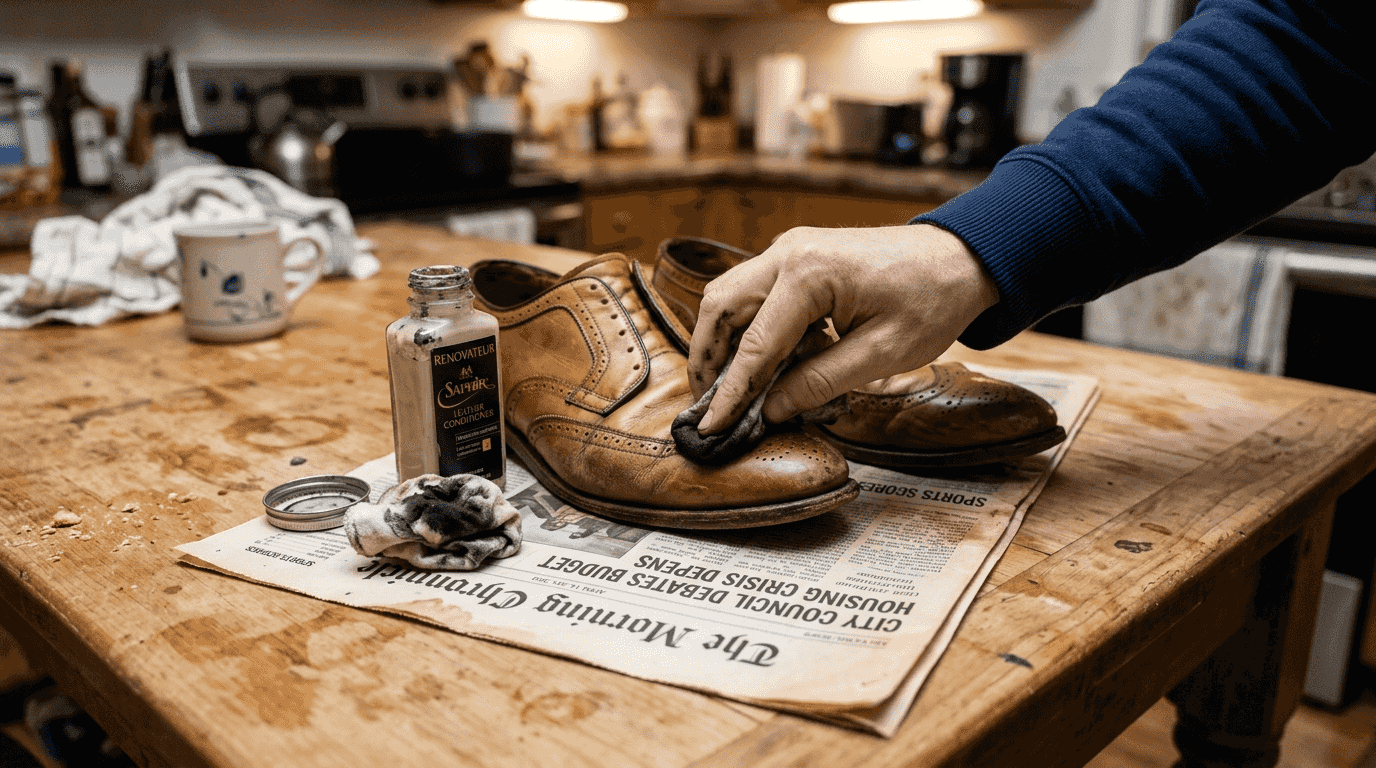
Step 4: Nourish with premium cream. Products like Saphir Medaille d’Or Creme Pommadier deliver deep nourishment while adding subtle color enhancement. Apply a thin layer using a small applicator brush or cloth. This step replenishes oils lost through wear and environmental exposure. The cream should disappear into the leather rather than sit on the surface. Techniques like leather shoe burnishing build on this foundation to create depth and definition.
Step 5: Protect with wax polish. Select a high-quality wax polish matching your shoe color. Apply very thin layers using a soft cloth or polish brush. Multiple thin coats build superior protection and shine compared to one thick application. Allow each layer to dry for several minutes before buffing with a horsehair brush. For mirror shine on toe caps and heels, apply additional thin wax layers with a damp cloth, buffing between applications.
Pro Tip: Use small circular motions when applying all products, and always work with thin layers to avoid buildup that dulls appearance and prevents proper leather breathing.
Common mistakes undermine even the best products. Over-wetting leather during cleaning causes water stains and structural damage. Skipping conditioning after cleaning leaves leather vulnerable to cracking. Applying too much product creates sticky buildup that attracts dirt. Rushing between steps prevents proper absorption and drying. Maintaining a regular routine, ideally after every 5-7 wears, keeps shoes in optimal condition and makes each session quicker and easier.
Verification: maintaining shoe shape and finishing touches
Preserving shoe structure between wears proves as critical as the cleaning process itself. Professional maintenance extends beyond surface treatment to address the fundamental shape and moisture management that determine long-term durability.
Insert cedarwood shoe trees immediately after removing your shoes, while leather remains warm and pliable. Using cedarwood shoe trees helps retain shoe shape while absorbing the significant moisture your feet generate during wear. A single day of wear can deposit up to a quarter cup of perspiration into shoe leather. Without proper moisture management, this dampness weakens leather fibers and promotes bacterial growth that causes odor.
Quality shoe trees maintain structural integrity by gently stretching leather back to its original form. This counters the natural creasing and compression that occurs during walking. Cedarwood offers the additional benefit of natural odor neutralization through its aromatic oils. Avoid plastic or metal alternatives that trap moisture rather than absorbing it. The investment in proper shoe trees, typically $30-50 per pair, pays for itself many times over through extended shoe life.
- Insert trees immediately after wear, not hours later when leather has already begun setting in compressed positions
- Choose trees sized specifically for your shoes; too small provides insufficient support while too large can overstretch leather
- Replace trees every few years as cedar loses its aromatic and moisture-absorbing properties
- Use separate trees for each pair rather than swapping between shoes to maintain proper fit
Final polishing delivers the refined appearance expected in professional environments. This finishing phase requires patience and technique. Apply your final wax layer in extremely thin coats, allowing adequate drying time between applications. The entire polishing process, from initial cleaning through final buffing, can take 45-60 minutes for optimal results. Rushing compromises both appearance and protective benefits.
Pro Tip: Rotate between at least three pairs of formal shoes, allowing each pair a full 48 hours rest between wears to fully dry and recover its shape.
Proper storage protects your investment when shoes aren’t in use. Keep shoes in breathable cotton bags rather than plastic, which traps moisture and promotes mildew. Store away from direct sunlight that fades color and heat sources that dry and crack leather. Maintain a consistent temperature and moderate humidity in storage areas. Understanding what is patina leather helps you appreciate how proper storage contributes to the desirable aging process that enhances rather than degrades appearance.
| Maintenance Task | Frequency | Time Required |
|---|---|---|
| Surface brushing | After each wear | 2 minutes |
| Deep cleaning and conditioning | Every 5-7 wears | 30-40 minutes |
| Full polish application | Monthly or as needed | 45-60 minutes |
| Shoe tree insertion | After every wear | 1 minute |
The professional impact and return on investment of expert shoe care
The financial and professional returns from consistent shoe care far exceed the time and product investment required. Neglecting luxury formal shoes dramatically shortens their functional lifespan, forcing premature replacement that costs hundreds or thousands of dollars. A $600 pair of quality dress shoes maintained properly can serve 8-10 years or longer. The same shoes neglected might require replacement within 2-3 years.
Proper leather shoe care significantly extends luxury shoe lifespan, with maintenance routines delivering up to 50% longer wear. This translates directly to substantial cost savings. Consider a professional owning four pairs of formal shoes at $500 each. With proper care extending lifespan from 3 to 6 years, the savings over a decade exceed $3,000 in avoided replacement costs. The investment in care products and shoe trees totals perhaps $300 over the same period.
Well-maintained shoes develop desirable patina that enhances both aesthetic appeal and monetary value. Unlike neglected shoes that simply look worn, properly cared for leather develops rich color depth and character. This aging process actually increases value for high-quality shoes, particularly those with Goodyear welt construction that allows resoling. Collectors and discerning buyers pay premium prices for well-maintained vintage formal shoes.
Your professional image depends significantly on footwear appearance. In high-income sectors like finance, law, and consulting, polished shoes signal attention to detail and personal standards. Scuffed, cracked, or poorly maintained shoes undermine credibility regardless of suit quality or credentials. The luxury formal shoe market, valued at USD 134.35 billion, reflects the importance professionals place on quality footwear.
| Scenario | 5-Year Cost | Shoe Condition | Professional Impact |
|---|---|---|---|
| Regular expert care | $1,000 (initial) + $200 (products) | Excellent, developing patina | Conveys professionalism and attention to detail |
| Minimal care | $3,000 (3 replacements) | Poor, visible wear | Suggests carelessness, undermines credibility |
The time investment proves minimal compared to benefits. A weekly 5-minute brushing session and monthly 45-minute deep care routine totals roughly 15 hours annually. This modest commitment protects investments worth thousands while ensuring you always present your best professional image. The return on this time investment, measured in extended shoe life and enhanced appearance, yields exceptional value.
- Consistent care routines prevent the expensive emergency replacements that occur when neglect causes irreparable damage
- Well-maintained shoes retain resale value, an important consideration for limited edition or custom footwear
- Professional cobblers can resole and refurbish properly maintained shoes, impossible with neglected pairs where upper leather has deteriorated
- The confidence that comes from knowing your appearance is impeccable delivers intangible but real professional benefits
Enhance your shoe care with premium leather goods from MySartorial
Maintaining your formal footwear excellence extends naturally to the complete professional wardrobe. MySartorial offers premium leather goods and belts crafted with the same attention to quality and detail that your shoes demand. Our collection features handcrafted European leather accessories designed to complement your formal footwear while providing the durability that professional life requires.

Each piece in our leather goods collection receives the same meticulous craftsmanship as our signature footwear. From belts that coordinate perfectly with your shoe color to leather accessories that complete your professional presentation, we provide the quality you need. Explore our expert leather craftsmanship to discover how traditional European techniques create accessories worthy of your investment in maintaining excellence.
FAQ
How often should I clean and condition my formal leather shoes?
Clean and condition your shoes after every 5-7 wears under normal conditions. Increase frequency if you encounter rain, snow, salt, or other harsh environmental factors. Light brushing after each wear removes surface dirt before it embeds, making deep cleaning sessions more effective and less frequent.
Can I use any shoe cream or polish on luxury leather shoes?
No, use only products specifically designed for your leather type and quality level. Premium products like Saphir Medaille d’Or formulations contain higher concentrations of nourishing ingredients without harsh chemicals. Generic drugstore products often contain silicones and petroleum distillates that damage fine leather over time.
What is the role of cedarwood shoe trees in shoe maintenance?
Cedarwood shoe trees serve three critical functions: they absorb moisture that weakens leather, maintain proper shoe shape by gently stretching the upper back to its original form, and neutralize odors through natural aromatic oils. Insert them immediately after wear while leather remains warm and pliable for maximum benefit.
How long does a full shoe polishing process typically take?
A complete polishing session, from initial cleaning through final buffing, requires 45-60 minutes for professional results. This includes proper drying time between product applications. Rushing the process by skipping drying intervals or applying thick product layers compromises both appearance and protective benefits.
Can regular shoe care actually save me money?
Yes, proper maintenance can extend shoe lifespan by up to 50%, dramatically reducing replacement frequency. A $500 pair of shoes lasting 6 years with care versus 3 years without represents $500 in savings, far exceeding the $50-75 annual cost of quality care products. Over a professional career, consistent care saves thousands in avoided replacements.