

What is Goodyear welted and why it matters in 2026
Many professionals assume Goodyear welted shoes are stiff and uncomfortable, dismissing them before experiencing the long-term benefits. That initial firmness signals superior construction methods that deliver decades of durability, water resistance, and personalized comfort. Understanding Goodyear welted construction transforms how you invest in luxury footwear, revealing why European craftsmen have trusted this technique since 1869.
Table of Contents
- Introduction To Goodyear Welted Shoes
- The Goodyear Welt Construction Process Explained
- Durability, Comfort, And Water Resistance Benefits
- How To Identify Authentic Goodyear Welted Shoes
- Common Misconceptions About Goodyear Welted Shoes
- Comparing Goodyear Welted Vs Other Shoe Constructions
- Practical Benefits: Longevity, Resoleability, And Investment Value
- Discover Custom Goodyear Welted Shoes At Mysartorial
- Frequently Asked Questions
Key takeaways
| Point | Details |
|---|---|
| Goodyear welted shoes use handcrafted construction with a leather welt stitched between upper and sole, enabling resoling and extended life. | |
| Cork filling molds to your foot after 10 to 15 wears, creating custom comfort and shock absorption impossible with glued shoes. | |
| Authentic shoes show visible stitching around the welt edge, distinguishing them from decorative stitching or cemented construction. | |
| These shoes last 5 to 10 years minimum with care, offering superior cost-per-wear value through multiple resolings. | |
| Common myths about stiffness and cost ignore the break-in reward and long-term savings from repairability. |
Introduction to Goodyear welted shoes
Goodyear welted construction revolutionized luxury footwear by introducing a leather strip called a welt that connects the shoe’s upper to its sole. This strip creates a durable frame allowing the outsole to be replaced without damaging the upper leather. Charles Goodyear Jr. invented the Goodyear welt machine in 1869, transforming European shoemaking from fragile glued assemblies to resoleable masterpieces.
European craftsmen quickly adopted this method because it balanced durability with elegance. The welt acts as a protective barrier, preventing moisture from entering through the sole while distributing stress evenly across the shoe structure. This construction became the hallmark of quality dress shoes, particularly in Italian and British workshops where custom luxury shoe crafting traditions demanded longevity.
The technique involves several distinct advantages:
- Resoleable design: The outsole attaches to the welt rather than the upper, allowing cobblers to replace worn soles multiple times.
- Water resistance: The welt creates a barrier that blocks moisture intrusion better than glued or Blake-stitched shoes.
- Comfort evolution: Cork filling between the insole and outsole molds to your foot shape, creating a personalized fit.
- Structural integrity: The stitching pattern distributes weight and stress, preventing premature wear in high-impact areas.
Understanding how the Goodyear welt functions helps you recognize authentic construction and avoid marketing gimmicks. The welt itself is a thin leather strip, typically 3 to 5 millimeters wide, running along the shoe’s perimeter. It connects three critical components: the upper leather, the insole rib, and the outsole. This triple connection creates a mechanical bond far stronger than adhesive alone.
The Goodyear welt construction process explained
Crafting a Goodyear welted shoe requires precision at each stage, distinguishing it from faster, cheaper methods. The process begins with attaching the upper leather to a last, a wooden form shaped like a foot. Craftsmen stretch the upper over the last and secure it to a cork-and-leather insole using tacks or cement.
Next comes the critical welt attachment. A specialized machine stitches the welt to the insole and upper using a lockstitch that penetrates through the insole rib. This stitch creates a watertight seal and anchors the welt firmly to the shoe’s foundation. The stitching runs continuously around the perimeter, visible as small, evenly spaced dots when you examine the shoe from below.
The construction follows these exact steps:
- Upper attachment: The leather upper is pulled taut over the last and fixed to the insole.
- Welt stitching: The welt strip is stitched to both the insole rib and the upper’s edge, forming a secure frame.
- Cork filling: Cork granules are packed into the cavity between the insole and the welt, creating a cushioning layer.
- Outsole attachment: The outsole is stitched to the welt’s outer edge, not the upper, enabling future resoling.
- Finishing: Edges are trimmed, polished, and sealed to complete the water-resistant barrier.
The cork filling plays a dual role. It cushions your foot during wear and gradually compresses to match your unique foot contours. After 10 to 15 wears, the cork conforms to pressure points, arches, and heel shape, delivering a fit rivaling bespoke shoes. This adaptability explains why Goodyear welted shoes feel stiff initially but become exceptionally comfortable over time.
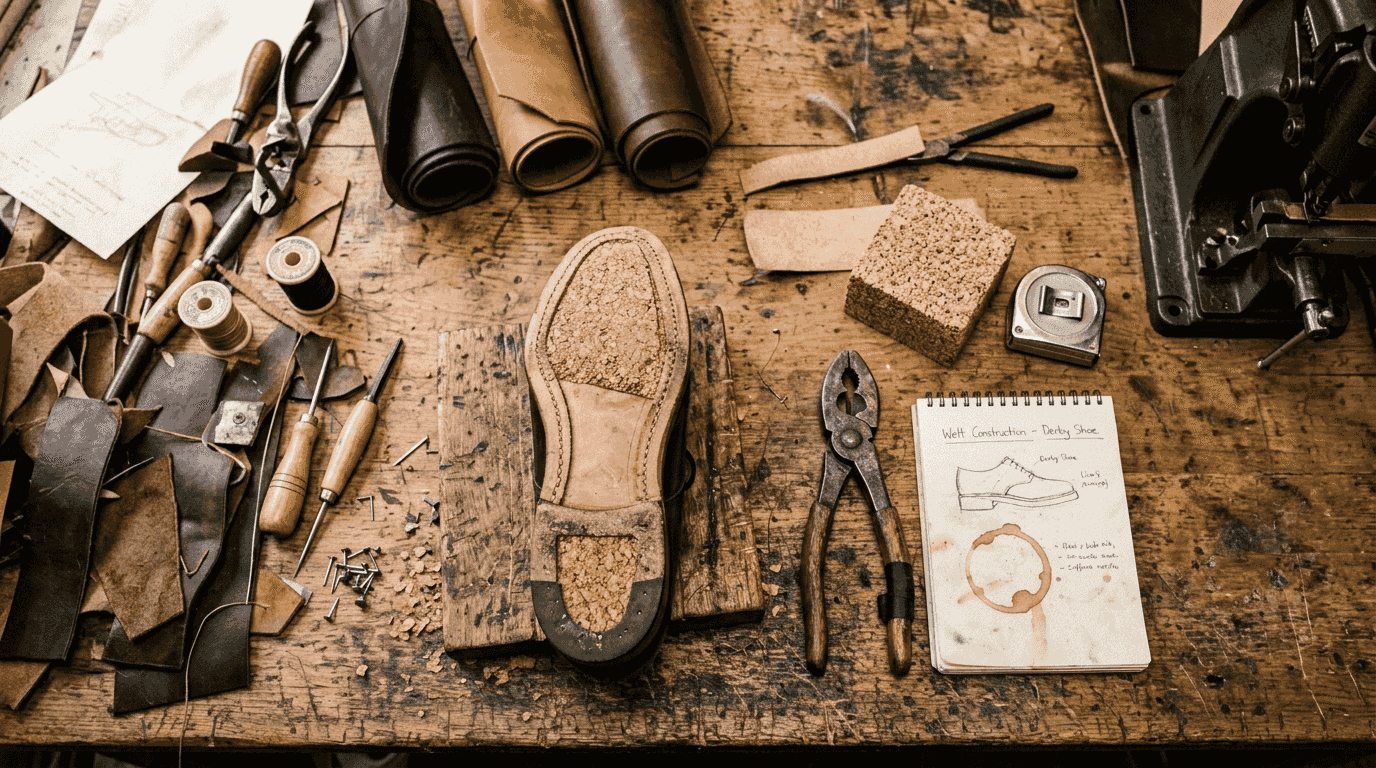
Pro Tip: Inspect the stitching line where the welt meets the outsole. Authentic Goodyear welted shoes show consistent, small stitches with no glue residue. If the stitching looks decorative or stops abruptly, the shoe likely uses a cheaper construction method dressed up to mimic Goodyear welt.
The mechanical advantage of this process lies in how forces transfer through the shoe. When you walk, pressure spreads across the welt rather than concentrating on glued seams. This distribution prevents sole separation and extends shoe life significantly. For professionals investing in customizing formal footwear, understanding this construction clarifies why certain shoes justify premium pricing.
Durability, comfort, and water resistance benefits
Goodyear welted shoes deliver performance advantages that justify their higher cost through measurable longevity. Properly maintained pairs last 5 to 10 years or more, far surpassing glued or Blake-stitched models that typically fail within 2 to 3 years. This durability stems from the resoleable design, allowing you to replace worn outsoles while preserving the upper leather and welted frame.
The comfort improvement happens gradually but dramatically. Cork filling compressed by your body weight creates a custom footbed matching your arch height, toe splay, and heel width. After the initial break-in period of 10 to 15 wears, the shoes feel molded specifically for you. This personalized fit reduces fatigue during long days and prevents blisters common with mass-produced shoes.
Water resistance represents another critical advantage. The welt barrier provides superior water resistance by creating a physical gap between the upper and the ground. Moisture must travel through the welt stitching to reach the interior, a path far more difficult than penetrating glued seams. This protection matters in professional settings where appearance and foot health both demand attention.
Key durability and comfort factors include:
- Multiple resolings: Shoes can be resoled 3 to 5 times before the upper wears out, extending total lifespan beyond 20 years.
- Cork molding: The footbed adapts to your unique foot shape, creating orthopedic-level support without custom insoles.
- Structural resilience: The stitched welt distributes stress evenly, preventing premature failure at high-wear points like the toe box.
- Moisture protection: The welt acts as a moisture barrier, keeping feet dry and preventing leather degradation from repeated wet exposure.
“Investing in Goodyear welted construction means buying one pair of shoes that outlasts five cheaper alternatives, delivering better comfort with each wear while reducing long-term footwear costs.”
The economic logic becomes clear when calculating cost-per-wear. A $400 pair of Goodyear welted shoes worn 200 times per year for 8 years equals $0.25 per wear. Compare that to $100 glued shoes lasting 2 years at the same frequency: $0.25 per wear initially, but requiring four replacements over 8 years totals $400 with no improvement in fit. The Goodyear welted pair offers superior comfort, durability, and total value.
For professionals prioritizing handcrafted footwear durability, these benefits align perfectly with wardrobe investment strategies. Understanding Goodyear welt durability transforms footwear from a disposable expense into a durable asset that improves with age.
How to identify authentic Goodyear welted shoes
Recognizing genuine Goodyear welted construction protects you from marketing deception and ensures you receive the quality you pay for. The most reliable indicator is the stitching pattern visible along the shoe’s bottom edge. Authentic Goodyear welted shoes show consistent stitching between the welt and outsole, running continuously around the perimeter without gaps or glue residue.
Examine the shoe from the side and bottom. You should see two distinct stitch lines: one attaching the welt to the upper and insole, another connecting the welt to the outsole. These stitches appear as small, evenly spaced punctures, not decorative grooves or pressed patterns. Some manufacturers add fake stitching to cemented shoes, mimicking Goodyear welt aesthetics without the structural benefits.
Authentic identification requires checking these features:
- Continuous welt stitching: Real Goodyear welted shoes show uninterrupted stitching around the entire shoe perimeter, visible from below.
- Cork filling presence: Gently press the insole. Authentic shoes have slight give from cork compression, while glued shoes feel rigid.
- Removable insole: Many Goodyear welted shoes feature removable insoles revealing the cork layer underneath, though some luxury makers use permanent insoles.
- Brand reputation: Established makers like Alden, Crockett & Jones, and custom workshops consistently deliver authentic Goodyear welted construction.
- Price point: Genuine Goodyear welted shoes rarely cost under $250 due to labor intensity, though exceptions exist during sales.
Pro Tip: Ask the retailer if the shoes can be resoled. Authentic Goodyear welted shoes are always resoleable because the outsole attaches to the welt, not the upper. If the answer is vague or negative, the construction likely uses cheaper methods despite marketing claims.
Decorative stitching represents the most common deception. Manufacturers press grooves into cemented soles, creating the appearance of welt stitching without functional benefits. Run your finger along the stitching line. Authentic stitches have slight depth and texture, while fake grooves feel smooth and uniform. This tactile test quickly separates genuine construction from imitation.
For specific examples, examine Longwing Blucher Goodyear shoes or Full Brogue Goodyear shoes to see authentic construction details. These models display clear welt stitching and offer customization options that leverage Goodyear welt’s structural advantages.
Common misconceptions about Goodyear welted shoes
Many buyers avoid Goodyear welted shoes based on outdated or incomplete information, missing out on superior footwear. The most persistent myth claims these shoes never become comfortable, citing the initial stiffness as a permanent flaw. In reality, the initial stiffness leads to greater comfort as cork molds to your foot shape, creating a custom fit impossible with softer, pre-molded footbeds.
Another misconception targets cost. Critics argue Goodyear welted shoes cost too much compared to alternatives, ignoring the total ownership expense. While Goodyear welted shoes are more expensive upfront due to labor intensity, they provide significant long-term savings through resoling. Replacing a worn outsole costs $80 to $150, far less than buying new shoes every few years.
Common myths that deserve correction:
- Myth: Break-in period is unbearably long: The break-in typically lasts 10 to 15 wears, shorter than bespoke shoes and rewarded with superior long-term comfort.
- Myth: Only formal shoes use Goodyear welt: While most common in dress shoes, the construction appears in boots, casual derbies, and even some luxury sneakers.
- Myth: Resoling costs nearly as much as new shoes: Professional resoling ranges from $80 to $150, preserving your broken-in upper and custom cork footbed for 20% of new shoe cost.
- Myth: Modern glued shoes match Goodyear welt quality: Adhesive technology improved, but glued shoes still cannot be resoled and lack the water resistance of welted construction.
The discomfort myth particularly damages buyer confidence. New Goodyear welted shoes feel stiff because the cork hasn’t compressed and the leather hasn’t flexed. This temporary phase is necessary for the shoe to adapt to your specific foot shape. Rushing this process with excessive wear causes blisters, reinforcing the discomfort perception when patience would reveal exceptional fit.
“The initial firmness of Goodyear welted shoes is not a flaw but a feature, signaling that the construction will adapt to your unique foot rather than forcing your foot to adapt to a generic mold.”
Price concerns often ignore cost-per-wear calculations. A $400 Goodyear welted shoe worn 200 times yearly for 8 years costs $0.25 per wear. A $100 cemented shoe lasting 2 years at the same frequency requires four replacements totaling $400, with declining comfort as each pair ages. The Goodyear welted pair delivers better value and continuously improving fit.
Understanding these misconceptions helps you evaluate footwear investments rationally. The Goodyear welt break-in period rewards patience with decades of superior performance, while Goodyear welt shoe cost delivers unmatched long-term value for professionals building quality wardrobes.
Comparing Goodyear welted vs other shoe constructions
Goodyear welted shoes compete primarily with Blake stitch and cemented construction, each method offering distinct tradeoffs. Goodyear welted shoes offer superior durability and resoling capabilities compared to both alternatives, though each method serves specific footwear needs.
Blake stitch construction stitches the outsole directly to the insole and upper without a welt, creating a sleeker profile. This method produces lighter, more flexible shoes ideal for warm climates and unstructured styles. However, Blake stitched shoes offer less water resistance and fewer resoling opportunities. The direct stitch penetrates the insole, creating a moisture pathway absent in Goodyear welted shoes.
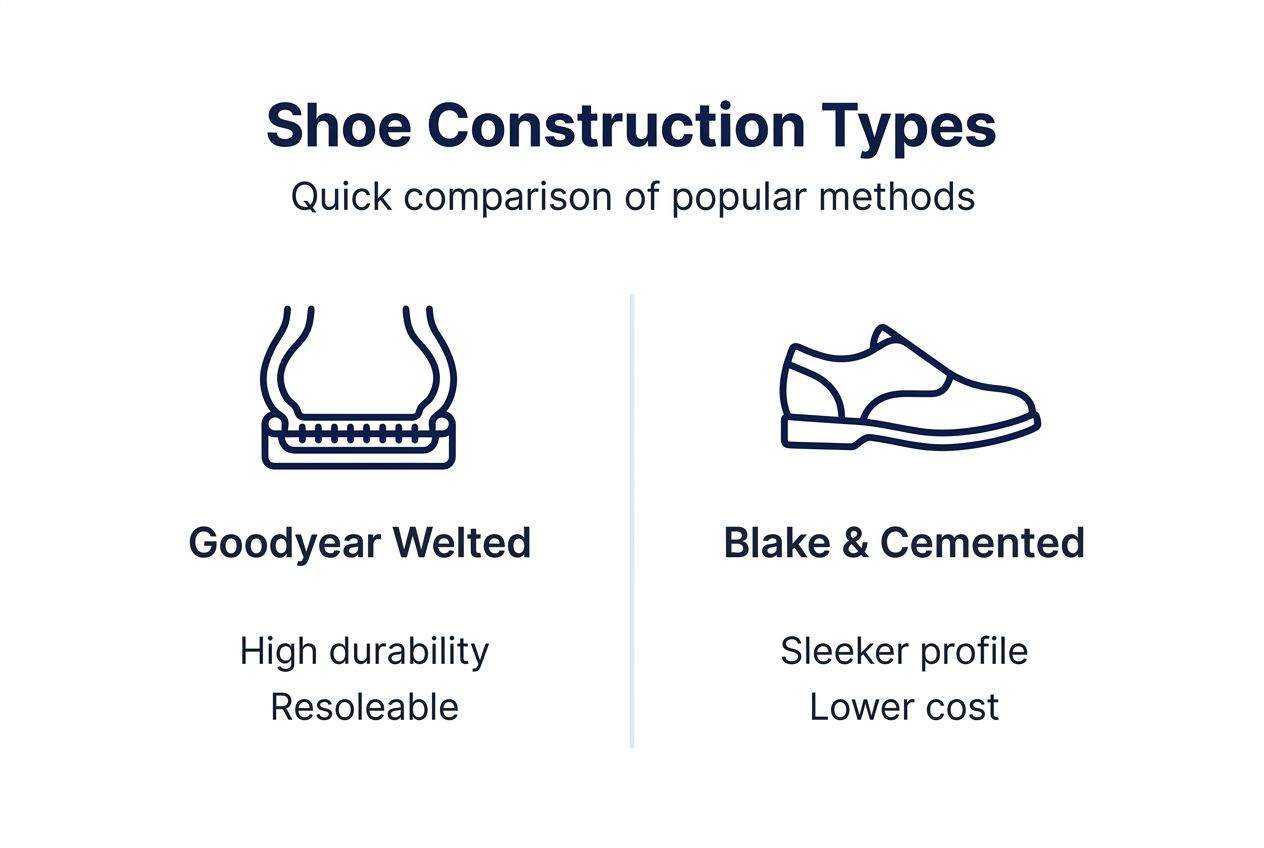
Cemented construction uses adhesive to bond the outsole to the upper, eliminating stitching entirely. This approach allows mass production at low cost but sacrifices durability and repairability. When the glue fails or the sole wears through, the entire shoe becomes garbage. Cemented shoes suit athletic footwear and ultra-casual styles where replacement frequency matters less.
| Feature | Goodyear Welted | Blake Stitch | Cemented |
|---|---|---|---|
| Durability | 5 to 10+ years with care | 3 to 5 years typical | 1 to 3 years maximum |
| Resoling | Easy, multiple times | Possible but limited | Impossible |
| Water resistance | Excellent welt barrier | Moderate, stitches penetrate | Poor, glue degrades |
| Comfort evolution | Cork molds to foot | Minimal change | No adaptation |
| Initial cost | $250 to $800+ | $150 to $400 | $50 to $150 |
| Weight | Heavier, sturdier | Lighter, flexible | Lightest option |
The structural differences create performance gaps that matter for professional footwear. Goodyear welted shoes handle wet conditions better because the welt creates a physical barrier between the upper and ground. Blake stitched shoes allow moisture through the stitch holes in the insole, potentially damaging leather and causing discomfort. Cemented shoes offer no barrier at all, relying entirely on leather treatment for water resistance.
Comfort development differs dramatically across methods:
- Goodyear welted: Cork filling compresses and molds over 10 to 15 wears, creating custom footbed matching your arch and pressure points.
- Blake stitch: Minimal comfort evolution beyond leather break-in, as no cork layer exists between insole and outsole.
- Cemented: No structural comfort improvement, though foam insoles may compress slightly before degrading.
For professionals investing in quality footwear, understanding Goodyear welt vs Blake stitching clarifies when each method suits specific needs. Goodyear welted construction excels for dress shoes, boots, and any footwear requiring longevity. Blake stitch works well for warm-climate dress shoes where lighter weight and flexibility outweigh water resistance concerns. Cemented construction belongs in athletic shoes and disposable casual footwear.
Practical benefits: longevity, resoleability, and investment value
Goodyear welted shoes transform from an expense into an asset when you calculate total lifecycle value. Properly maintained Goodyear welted shoes can last over 20 years, offering unmatched cost-per-wear value and eco-friendly benefits through extended use and multiple resolings.
Resoling capability creates the most tangible economic advantage. When the outsole wears through after 2 to 4 years of regular use, a cobbler can stitch a new sole to the existing welt for $80 to $150. This process preserves your broken-in upper leather and custom-molded cork footbed, maintaining the personalized fit you’ve developed. Compare this to replacing cemented shoes entirely at $100 to $300 per pair.
The economic math favors Goodyear welted construction decisively:
- Initial investment: $400 for quality Goodyear welted shoes.
- First resoling: $120 after 3 years, extending life 3 more years.
- Second resoling: $120 after 6 years total, extending to 9 years.
- Third resoling: $120 after 9 years, reaching 12+ years total lifespan.
- Total cost: $760 over 12 years equals $63 annually or $0.17 per wear at 365 wears yearly.
Sustainability adds another dimension to the investment case. Goodyear welted shoes reduce waste dramatically by avoiding landfill disposal every few years. The resoling process reuses 80% of the original shoe, requiring only new outsole material and cobbler labor. For environmentally conscious professionals, this construction aligns footwear choices with sustainability values without sacrificing quality.
Pro Tip: Establish a relationship with a skilled cobbler before your shoes need resoling. Quality craftsmen can also replace heels, condition leather, and repair stitching, extending shoe life well beyond the 20-year mark. Ask about their experience with Goodyear welted shoes specifically, as the technique requires specialized equipment.
Maintenance practices maximize these longevity benefits. Rotate shoes daily to allow leather to dry and cork to decompress. Use shoe trees to maintain shape and absorb moisture. Condition leather every 3 to 6 months depending on climate and wear frequency. These simple habits protect your investment and preserve the comfort gains from cork molding.
Beyond direct savings, Goodyear welted shoes offer intangible value through consistent appearance and reliable performance. Professionals can confidently wear the same high-quality shoes for years without visible degradation. The broken-in comfort and personalized fit eliminate the adjustment period required when replacing cheaper shoes, maintaining productivity during long workdays.
For those exploring quality accessories, leather goods & belts and leather works complement Goodyear welted shoes perfectly. Understanding long-lasting Goodyear welted shoes transforms how you build a professional wardrobe, shifting from disposable fashion to durable investments.
Discover custom Goodyear welted shoes at MySartorial
Now that you understand why Goodyear welted construction delivers unmatched durability and comfort, explore how MySartorial brings this craftsmanship to your exact specifications. Our handcrafted shoes combine traditional European techniques with modern customization, letting you choose leather finishes, stitching colors, sole types, and patina styles that match your taste.
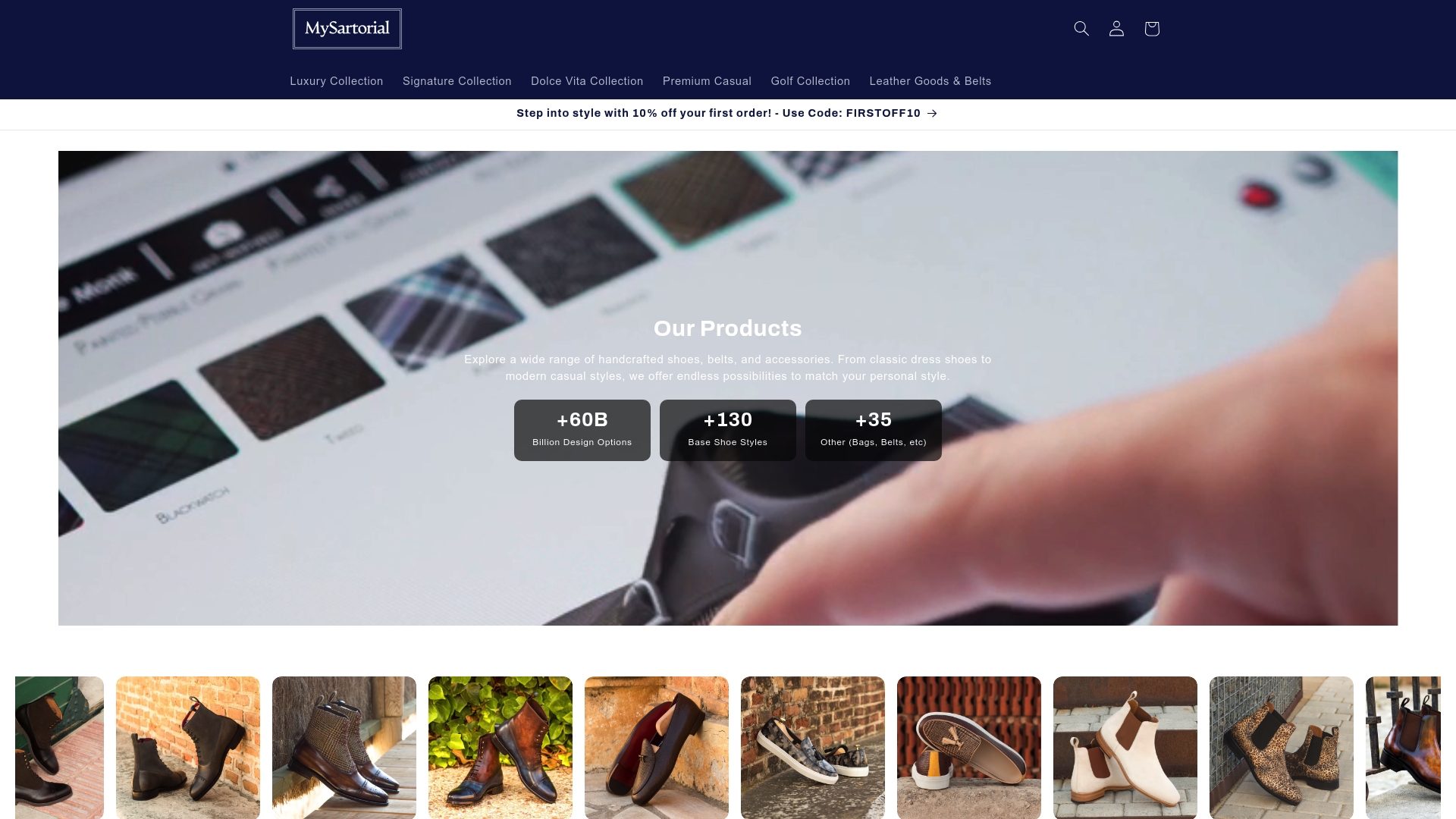
Every pair starts with authentic Goodyear welted construction, ensuring your investment lasts decades with proper care and resoling. Whether you need refined dress shoes for professional settings or elevated casual styles for weekend wear, our collections offer extensive options. Explore our leather goods & belts to complete your wardrobe with matching accessories, or visit our leather works page to see the craftsmanship behind each piece. For detailed construction comparisons, read our guide on Goodyear welt vs Blake stitching to make informed decisions.
Frequently asked questions
What is Goodyear welted?
Goodyear welted describes a shoe construction method where a leather strip called a welt connects the upper to the sole through stitching rather than glue. This technique, invented in 1869, allows the outsole to be replaced multiple times without damaging the upper, extending shoe life beyond 20 years. Cork filling between the insole and outsole molds to your foot shape over time, creating custom comfort.
How does the cork filling improve shoe comfort?
Cork acts as a shock absorber and gradually compresses under your body weight to match your unique foot contours. After 10 to 15 wears, the cork molds to your arch height, toe splay, and heel width, creating a personalized footbed rivaling custom orthotics. This adaptation explains why Goodyear welted shoes feel stiff initially but become exceptionally comfortable over time.
Are Goodyear welted shoes suitable for casual wear?
Goodyear welted construction appears primarily in dress shoes, boots, and luxury footwear due to its formal aesthetic and structured build. While less common for athletic or highly casual shoes, some makers offer welted derbies, chukkas, and even premium sneakers. The method’s durability and comfort benefits apply equally to casual styles when executed properly.
How often can Goodyear welted shoes be resoled?
Shoes can typically be resoled 3 to 5 times before the upper leather wears out, extending total lifespan beyond 20 years with proper care. Each resoling costs $80 to $150 and takes 1 to 3 weeks, preserving your broken-in upper and custom-molded cork footbed. This repairability makes Goodyear welted shoes far more economical than disposable alternatives over their lifecycle.
Is the higher price of Goodyear welted shoes worth it?
Initial cost is offset by extended durability and multiple resolings, delivering superior cost-per-wear value. A $400 pair worn daily for 12 years with three resolings costs roughly $0.17 per wear, compared to $0.25+ for cheaper shoes requiring replacement every 2 years. The investment buys unmatched comfort, craftsmanship, and sustainability that disposable footwear cannot match.
For more insights on luxury footwear and customization options, visit the MySartorial blog to explore guides on shoe care, construction techniques, and style recommendations.